




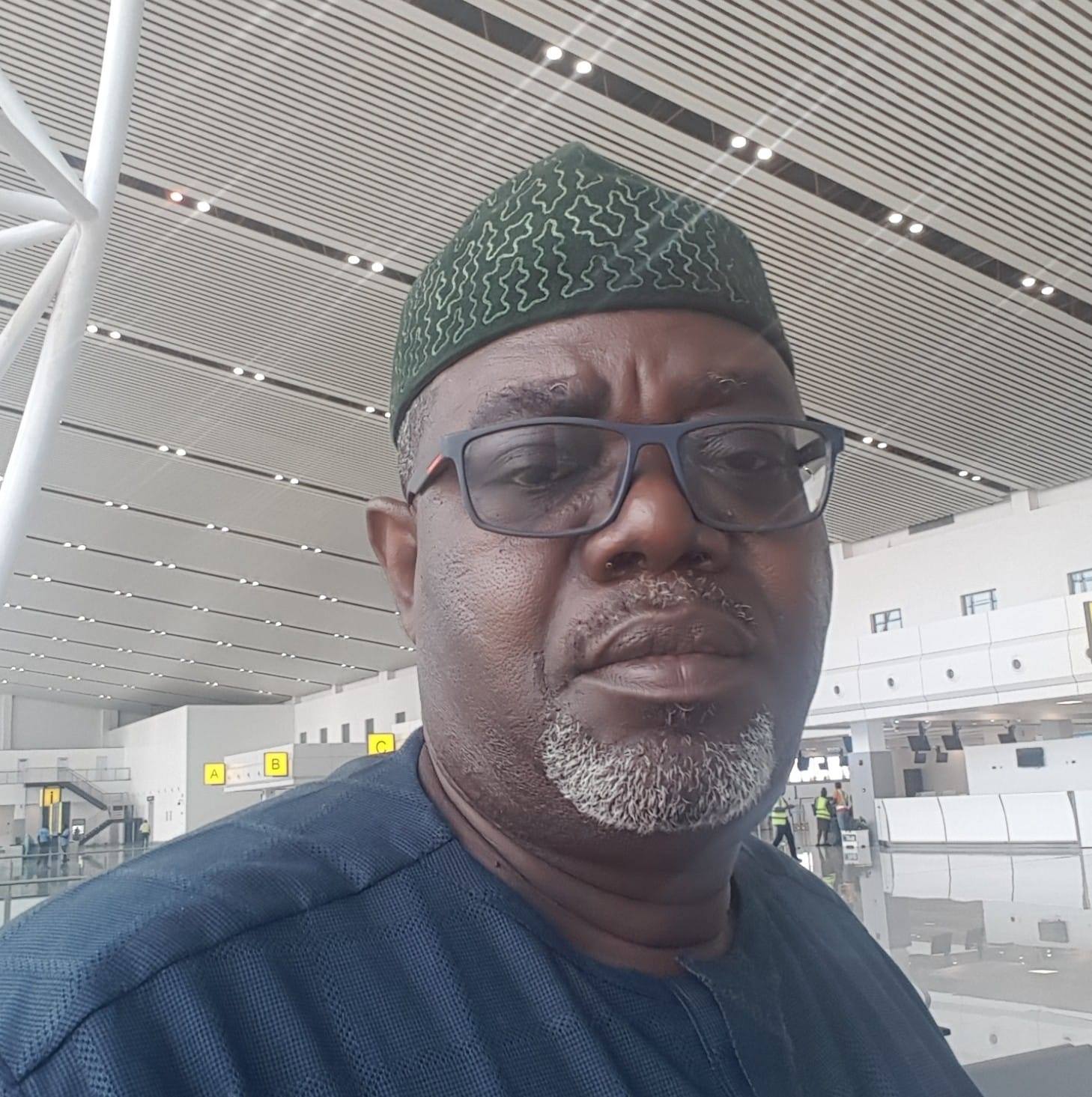
By ABDUL OROH
During the launching of my book, Demonstration of Craze: Struggles and Transition to Democracy in Nigeria, Ajuluchukwu Brown, a young reporter with The Guardian approached me and asked for an interview. To test his resilience, I told him I was quite busy at that moment but I introduced him to Professor Abiodun Adeniyi, a former reporter with The Guardian and now a professor of Communication and Registrar of Baze University Abuja. I then told him I also started my career at The Guardian in 1983.
To me it was just like yesterday, but that was 42 years ago. I asked the young journalist what that meant to him. Waooo, he replied. I then told him to think of how to be better than me and the professor whose job that day was to review my book about the history of the struggle against military dictatorship in Nigeria.
Shortly afterwards, he rushed off with the excuse that he was running late for another assignment. We agreed to meet the next day at my office. When he called me in the morning, to remind me about the appointment, I directed him to a hotel in Jahi district of Abuja where the International Press Center was organizing an event to mark the 11th anniversary of the enactment of the Freedom of Information Act.
Brown arrived at the event before me. He reminded me of my younger days as a journalist with the same newspaper, the excitement of getting exclusive stories and the sheer pleasure of reading them when published.
On the high table at the event were two other former journalists of The Guardian – John Kayode Fayemi, former Governor of Ekiti State and Edetaen Ojo, Executive Director of Media Rights Agenda, MRA who, for over twenty five years, has worked passionately to transform Nigeria to an open society, where access to public record and information would not only promote transparency and accountability in governance, but would encourage an informed citizenry to build their democracy and consolidate it beyond reversal by making informed choices during elections.
The Freedom of Information Act (2011) accented to by President Goodluck Jonathan on the 28th of May 2011, was a landmark legislation and a historical document. It was the first piece of legislation drafted by the Civil Liberties Organisation CLO in collaboration with the Media Rights Agenda, the Center for Free Speech, and the Lagos State branch of the Nigerian Union of Journalists NUJ to be enacted into Law by the National Assembly.
The idea of a legislation that would not only boost press freedom and freedom of expression guaranteed in the constitution started when the General Ibrahim Babangida and the military junta unleashed a wave of repression of the Nigerian press.
The high point of the repression was the assassination of Dele Giwa, Editor-in-Chief of Newswatch magazine by agents believed to be from the military intelligence. The incessant closure of newspapers by the junta and the unrelenting arrests and murder of journalists was the sword of Damocles known as Public Officers Against False Accusation Decree number 4 of 1984 under which my colleagues at The Guardian, Nduka Irabor and Tunde Thompson were imprisoned for a year in 1986.
Although repealed by the new junta to assuage public opinion and gain some modicum of legitimacy after the palace coup which ousted the Buhari-Idiagbon tyranny, the successive tyrants continued to dangle the mythical sword over the head of journalists.
Tyranny, thrives in closed societies riven with secret plots, heinous crimes, corruption, and self-serving manipulations of the political economy of the nation to nurture and sustain the tyranny.
Under such a system, facts are suppressed, myths are built around the cults and cliques who run the system and they are presented to the public as God sent, indispensable and messiah.
The first draft of the FOIA was done by the executive Director of the CLO, and his teamat a secret hide-out in Ijebu-Ode, at the height of repression, during the Abacha junta in 1995.
There was no hope that it would ever become law under the prevailing circumstance. The draft was built on hope that in the future, such legislation would, beyond the need to strengthen freedom of expression and of the press, will be a veritable tool for unearthing the truth about the uncomfortable aspect of history.
We felt the crimes committed in our names by successive regimes, buried in the deepest vaults of our national bureaucracy, should be made public, so the truth which we believed would save us all and heal the nation would be made public.
The law was a veritable proof that Civil Society and the government can collaborate in the national interest and public good. When the bill was presented to the 4th National Assembly, I had the privilege of leading the CLO team to the House of Representatives, during a public hearing.
With the dogged effort of Tony Anyanwu, Jerry Igbokwe, Nduka Irabor, Ibrahim Zailani and other progressive members of the National Assembly, the Bill was passed by the House but the president vetoed the bill.
During the 5th National Assembly, I was privileged to serve as one of the law makers. I also served as co-chair with Senator Udoma Egba SAN of the National Assembly Conference committee which passed the bill in 2026.
President Obasanjo who claimed to be the father of modern Nigeria, again vetoed the bill. He had also vetoed the bill establishing the NDDC, but his veto was overridden by the National Assembly.
In 2011, President Jonathan who was widely vilified for alleged inefficiency ( I also thought he was not efficient) made history by assenting to the bill. That was eleven years ago.
Some civil society heroes of that moment include Edetaen, Osaro Odemwingie, Maxwell Kadiri, Richard Akinnola, Lanre Arogundade, Chidi Odinkalu, Ene Eneoche, Tunde Fagbonhula, SAN, Eze Anaba and Tive Denedo.
As we gathered at the hotel in Jahi, on May 30th the people of South East Nigeria marked the Biafra Day, a day that all Nigerians ought to be in their bended kneels, crying out in atonement and solemn prayers for the memory of those who died during the civil war, or if you will, the Nigeria-Biafra war.
But the main issue of the day was to review how effective the Act has been and how it could be used to improve the election management in Nigeria. With the whiff of politics in the air and Nigerians raising questions about how well their elected officials have performed, it becomes fairly pungent that the FOIA was a powerful tool available to citizens to demand accountability because ‘’transparency does not necessarily produce accountability’’ from those in government.
As Fayemi reminded the audience, neither accountability nor integrity is enough. In other words, it is not enough to simply proclaim how accountable a government is or to stress the goodness of the public officials, without an active population demanding that the figures be brought bare, and beyond the nuances, to ascertain whether the cost of the whole process of procurement is producing the result that is in the interest of the people.
As I told the small gathering, the Freedom of Information Act is a powerful tool to dig through graves of the dead, if necessary, or through a forensic audit of our past conduct and make the results available in the public sphere.
Nigerians should deploy the FOIA tool to ask the government to release the names of those who died during the civil war. I believe the figures available in the public sphere are based on speculations and assumptions. I believe every victim comes from a family, clan, community and village. Even the children were given names and could therefore be identified.
A diligent inquiry can reveal the truth. The military ought to have the number of soldiers killed on both sides in their records. I don’t buy the idea of an unknown soldier. Every soldier enlisted, trained and deployed through a particular unit cannot be described as unknown.
The people of Nigeria deserve to know how many Nigerians have been killed since independence as a result of internal conflicts, wars, terrorism, banditry, common crime, political thuggery, militia violence and other sundry crimes. Nigerians ought to know the number of people internally displaced, refugees in foreign countries especially in our neighboring countries, Nigerians in diaspora, Nigerians migrants legal or illegal that have crossed the Mediterranean or the Atlantic seas, etc.
The preamble to the FOIA, declared that the law was made to ‘’make public records and information more freely available, provide for public access to public records and information, protect public records and the information to the extent consistent with the public interest and the protection of personal privacy, protect serving public officers from adverse consequences of disclosing certain kinds of official information without authorization and establish procedures for the achievement of those purposes and; fro related matters’’.
The Act also scrapped the official secret Act, a colonial legislation used by government bureaucrats and agencies to justify lack of accountability and transparency in governance. The law was explicit about the objective and intendment of its makers when it declared that: ‘’Notwithstanding anything contained in any other Act, law, regulation, the right of any person to access or request information, whether or not contained in any written form, which ids in the custody or possession of any public official, agency or institution howsoever described, is established.’’
The Supreme Court has adjudged the national jurisdiction of this act. As we left the hotel, Ajuluchukwu the young journalist from asked me why I titled my book, demonstration of craze; I replied that it was influenced by Fela’s music which described the imposed transition by the military as a parody of democracy which the military cannot teach the people. Democracy is a process that must be based on the expression of the free and informed will of the people and it cannot be imposed. He then reminded me that most Nigerian youths are yearning for a return to military rule because of the Captain Ibrahim Traore effect in Burkina Faso. I told him that I share the anti-colonial message of the young captain in Burkina Faso but military rule in Africa was a recipe for disaster and is inherently unstable, insecure and a disastrous adventure; therefore, there is nothing they can do differently by being the master of the people.
I told him that it was a contradiction formi the Captain and the ruling juntas in Niger and Mali to pull out of ECOWAS and be calling for African Unity while at the same time, trading French neo-colonialism for Russian murderous and authoritarian Putinism, both of them exploitative.
Our experience, which the young journalist was unfamiliar with, is that the military are also products of the society and their role is restricted to the defense of the state not as masters of the people. Military rule is not sustainable, not in Nigeria, Ghana or any part of West Africa. In Nigeria they left a legacy of corruption, plutocracy, religious and ethnic bigotry, tyranny, criminality, ethnic violence, and the destruction of our socio-economic and political fabrics.
They also created the division in the Armed forces, and thus, destroying professionalism and espirit d’corps. I advised him to read my book and have a feel of the depredations of military rule.
(Published by The Southerner on Sunday, June 1, 2025)
I always enjoy reading Abdul Oroh’s brilliant articles and comments. He reminds me of those group of great journalists like the late Dele Giwa and others of that era he mentioned in his piece.
However, whilst I completely agree that the military are product of society and their role is the defence of the state, and Military rule is not sustainable, I disagree that they are the ones who left a legacy of corruption, plutocracy, religious, and ethnic bigotry, destruction of our socio-economic and political fabrics. It is correct that Babangida, and Abacha promised these evils and them to become part of Nigeria’s culture. However, they existed during the government of Tarawa Balewa’ government in the first Republic hence we had coup and counter coup which led to barbaric civil war.
The politicians or political class must take responsibility for the failures of Nigeria and Africa. The Military will remain professional if the politicians can adhere to the Rule of Law and Good Governance. Nigeria and Africa will remain under developed and in irrelevant if we fail to adhere to the fundamental principles of rule of law and governance.