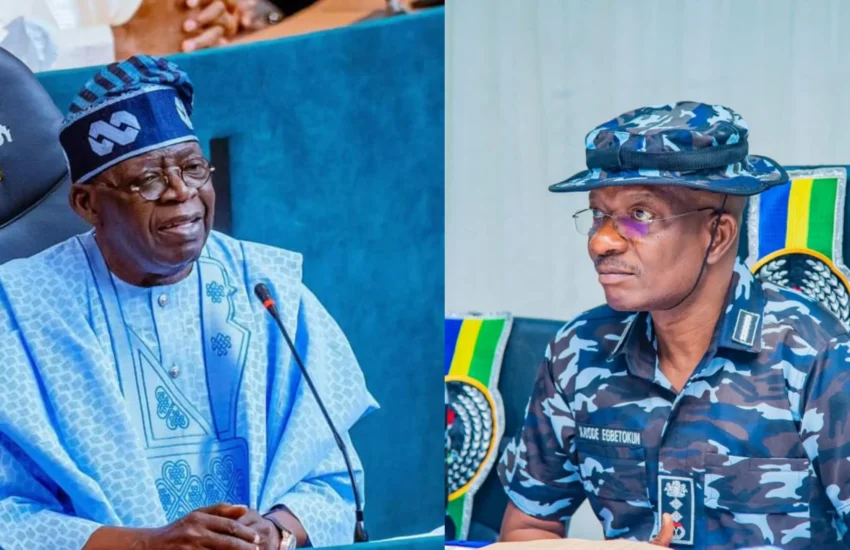
On February 28, 2026, President Bola Ahmed Tinubu did what Nigerians have been craving for, but which previous leaders somehow lacked the political will to initiate. Addressing an interfaith breaking of fast hosted for the leadership and members of the House of Representatives at the State House, Abuja, where Muslim and Christian lawmakers gathered in a symbolic show of unity during the Ramadan and Lenten seasons, Tinubu urged the federal lawmakers to, as a matter of urgency, consider constitutional amendments that would pave the way for the establishment of state police.
Making a strong case for state policing, the President stressed that decentralising the security architecture is essential to effectively tackle emerging threats.
It was not an familiar path for Nigeria. There were regional and local police forces in Nigeria immediately after independence in 1960. During the First Republic (1960–1966), Nigeria operated a federal structure where, alongside the national Nigeria Police Force (NPF), regional governments maintained their own police forces, particularly in the Northern and Western regions.
It was an arrangement diligently worked out by the post-Independence leaders that not only upheld the country’s federal structure, but also was effective in securing every part of the country.
The President requested a review of the 1999 Constitution to shift policing from the exclusive legislative list to the concurrent list, allowing states to establish their own security forces. Tinubu emphasized that security is local, necessitating a decentralized approach that complements federal agencies and urged lawmakers to structure the law carefully to prevent abuses seen with locally security in the past.
As in previous amendments of the 1999 constitution, the proposal needs approval from both arms of the National Assembly and at least 24 state houses of assembly.
This system would rely on local recruitment, enhancing community intelligence and responsiveness, while requiring robust accountability mechanisms to prevent abuse by state governors.
The core of establishing state police requires amending Sections 197, 214, and 215 of the 1999 Constitution, alongside the Police Act and Criminal Code.
States would establish their own independent, state-controlled forces. Local recruitment ensures officers are familiar with local cultures, languages, and security challenges, facilitating intelligence gathering. Establishing these forces requires significant investment in training academies, surveillance technology, and infrastructure, with estimates suggesting billions of naira needed for operational efficiency in each state.
That is hardly an insurmountable challenge. Under the present policing structure, the various state Police commands are poorly funded from Abuja and rely a most entirely on the states to have a measure of effectiveness.
An argument opponents of state Police often used to advance their opposition is the thinking, which to a large extent may be true, that state governors may use the police under their control to hound political opponents. To prevent such misuse, independent, robust oversight mechanisms are essential, ensuring compliance with human rights and preventing interference by local political players. We do not think cases of misuse of the Police is due to the absence of legal and administrative guardrails.
Rather, it is the failure of relevant bodies, especially the judiciary to uphold the guardrails.
In the United States of America whose federal structure Nigeria modelled the 1999 constitution, policing operates through a decentralized, cooperative system where the Federal Bureau of Investigation (FBI), federal government, handles national security and interstate crimes, while state police (state government) manage highway safety and local law enforcement assistance.
They are not strictly subordinate to one another but frequently work together through joint task forces, with shared jurisdiction in cases involving both state and federal laws. While the FBI (federal government) handles violations of federal criminal laws, terrorism, and civil rights violations, often spanning across multiple states, state police (state government) focuses on state highways, criminal investigations, and providing resources to local agencies.
We believe that with well defined areas of responsibilities, collaboration and effective independent oversight by civil society groups and the Nigerian Bar Association (NBA), state policing is the recipe for the restoration of security in our communities.
We congratulate President Tinubu for the bold decision in paving the way for states to set up their individual policing structure. It is, indeed, the way to go.