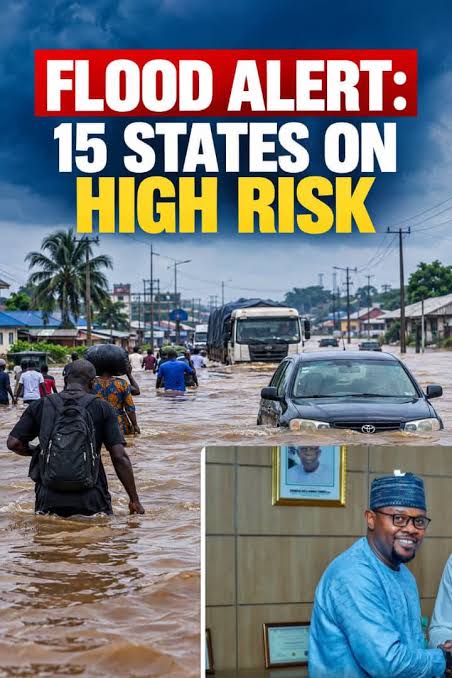
The latest warning from the Nigeria Hydrological Services Agency (NiHSA) deserves to be treated not as another seasonal announcement, but as a call for immediate preventive action. NiHSA issued a high riverine flood-risk alert covering 15 states from September 19–25, identifying Imo, Cross River, Ebonyi, Benue, Anambra, Akwa Ibom, Lagos, Rivers, Edo, Kogi, Taraba, Delta, Bayelsa, Enugu and Abia. The warning was based on projections of rising river levels, with nine river stations requiring close monitoring.
What makes the warning particularly significant is the scale of potential exposure. Reports based on the NiHSA assessment indicate that more than 8,000 communities and about 4,500 schools across the affected states could face flood risk, alongside healthcare facilities, markets, religious centres and farmlands. The message to governments at every level should therefore be simple: this is the time for prevention, not reaction.
Nigeria has become accustomed to the cycle. At the beginning of the rainy season, warnings are issued. Communities are alerted. Government agencies promise preparedness.
Yet, when the waters eventually rise, the country is often reduced to emergency evacuation, relief materials and appeals for assistance. This reactive approach is costly in lives, property and public resources.
The latest alert provides an opportunity to break that cycle.
State governments in the affected areas should immediately identify communities located on floodplains, riverbanks and other vulnerable terrain. Local emergency committees should be activated, evacuation routes identified and temporary shelters prepared before flooding becomes severe.
NEMA has already placed its zonal directorates and operations offices on standby following the NiHSA warning.
But emergency agencies cannot do the job alone.
Local governments, traditional rulers, community associations and religious organisations have an important role in ensuring that warnings reach people in language and forms they understand. In many rural communities, residents may not receive official advisories promptly.
Community leaders can bridge that communication gap.
Residents, too, must take the warnings seriously. People living in flood-prone areas should avoid waiting until water enters their homes before moving to safer locations. Important documents, medicines, food, livestock and other essential belongings should be protected in advance.
Parents should ensure that children are not exposed to flooded roads, drainage channels and fast-moving water.
There is also an urgent infrastructure question. Flooding is not caused by rainfall alone. Poor drainage, indiscriminate construction on waterways, blocked canals, inadequate waste management and uncontrolled development can turn heavy rainfall into a disaster. Governments must therefore combine immediate emergency measures with long-term flood-management policies.
The federal government should strengthen coordination among NiHSA, NEMA, the National Water Resources authorities, state emergency agencies and meteorological institutions.
Flood warnings are useful only when they are converted into timely action. NiHSA itself maintains flood-monitoring and early-warning systems intended to support preparedness.
Particular attention should be paid to vulnerable groups—children, older persons, persons with disabilities and people whose livelihoods depend directly on farms and waterways.
Evacuation plans that ignore these groups can create additional humanitarian problems.
The warning should also remind policymakers that flooding is no longer an occasional inconvenience. Nigeria’s own 2026 Annual Flood Outlook identified thousands of communities across the country as being at high risk during the year, underscoring the need for sustained investment in preparedness and resilience.
The affected states should consequently resist the temptation to treat the NiHSA alert as a routine bulletin that can be filed away. Every day between a warning and an actual flood should be used to save lives.
Nigeria cannot prevent every flood. It can, however, prevent many floods from becoming humanitarian disasters. Early evacuation, accurate information, functioning drainage systems, properly planned settlements, effective emergency response and disciplined development can dramatically reduce the consequences.
The present warning is therefore a test of governance. If governments act before the waters rise, the alert will have served its purpose. If they wait until communities are submerged before responding, another preventable tragedy will simply become another entry in Nigeria’s long history of flood disasters.