Sunday Southerner – Issues in the News
For years, the Tinubu administration has spoken about the removal of petrol subsidy with the confidence of a government that believes it has found the cure. Officials told Nigerians that the subsidy was a drain on the treasury, a fountain of corruption, and a distortion that enriched cartels while the poor paid the price. They promised that once it was gone, the savings would fund infrastructure, that the market would bring in new investment in refining, and that short-term pain would give way to long-term gain.
Each time a citizen questioned the arithmetic, the answer was the same: be patient, the reforms are working. Now, with transport fares climbing and commuters again queuing at filling stations, the same government has moved to adjust pump prices and to frame the move as relief. The contradiction is hard to miss. It reveals more about the government’s anxiety than about its policy.
Consider what the government has been saying. If subsidy removal was the right decision and its benefits were already visible, there would be no urgent need to intervene on pump prices to cushion transportation costs. A government that is confident its reforms are delivering would not hurry to reassure voters that prices will fall. The very act of adjusting prices to ease the burden concedes that the burden was real, that it was foreseeable, and that the promised gains had not arrived in time for ordinary households to feel them. It is an admission of chastisement wrapped in the language of benevolence.
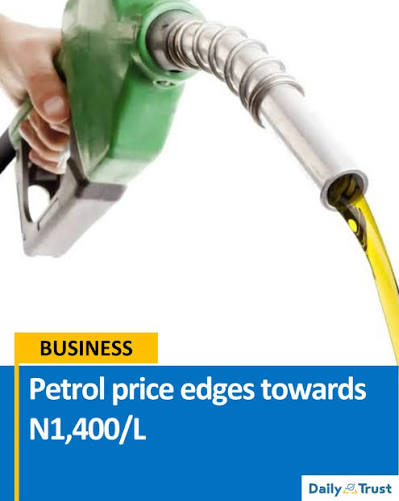
The reporting on the recent surge makes the point sharper. Pump prices in parts of Lagos and elsewhere have reportedly moved toward N1,400 to N1,500 per litre. That is far above the levels Nigerians were used to before the reforms, and the refinery’s gantry price has been adjusted several times upward in a single week. Much of the blame has been placed on global crude volatility linked to the conflict in the Middle East, and that is a real factor in an import-dependent economy. The federal Government, through its Minister of State for Petroleum, Heineken Lokpobiri, had said that prices of petrol in Nigeria were beyond President Bola Tinubu’s control.
The same government has announced an unimpactful reduction of the prices in a manner that suggests that, indeed, it was within government control.
Instead of a sustained plan to stabilise prices at home, the Tinubu government directed the deployment of 100,000 compressed natural gas conversion kits, an initiative that will take time to reach ordinary motorists. It also does nothing for the danger posed by the fares charged today.
Announcing a future solution while the present one drains wallets is a familiar political tactic, and Nigerians have seen it before.
What the October 8, 2026 decision by the government truly signals is desperation. Governments do not usually reverse course on the central economic philosophy they have defended in public unless they feel the political ground shifting beneath them. The 2027 general election is approaching, and the mood among voters is not hard to read. Many Nigerians feel that the government has spoken to them in the language of macroeconomic indicators while their daily lives grew more expensive.
Rent, food, school fees, passport charges and transport have all climbed, and the people carrying these costs have heard nothing that sounded like understanding from the government. The lack of empathy is not a mere perception created by opposition commentators. It is felt in the crowded danfo buses, in the traders who must now price their goods higher, and in the civil servants whose salaries no longer stretch beyond the first week of the month.
When a government feels that empathy is missing, it often tries to purchase it after the fact. A pump price adjustment is an easy gesture to make. It is visible, it is immediate, and it can be packaged as a victory over the same market forces the government had insisted were beyond its control. Yet the gesture also exposes the inconsistency. If market forces demand reform, they cannot also be blamed when the market rises and then be credited when the market falls.
A coherent economic policy would explain the trade-offs honestly from the start, including the likelihood that prices would be volatile for years. Instead, citizens were told that a short season of hardship would deliver prosperity, and now they are asked to applaud a price cut that merely restores an insignificant and minute fraction of what was lost.
Unfortunately, the electorate has long memories of such patterns. Nigerian voters have endured many promises about the economy since 2015, when APC arrived on the stage promising eldorado after a short time of pain. What they have seen instead is sustained pain. The pain ranges from the dividends of democracy that have not been delivered in almost 12 years to the rewards of structural adjustment. For these, Nigerians have learned to measure governments by what reaches their pockets, not what government press releases say. The thumb they are preparing to use in 2027 is not a gesture of spite but a judgment shaped by repeated disappointment.
When a government admits, through its own actions, that the pain of its policies was greater than it had acknowledged, voters are entitled to ask why they should trust the next set of assurances.
None of this means that the reform debate is settled or that the Nigerian state can continue indefinitely with the old subsidy arrangements. The subsidy was expensive, opaque and abused, and any government serious about fiscal discipline would have to confront it. But seriousness requires honesty about costs, a credible plan to protect the vulnerable, and a willingness to acknowledge when projections were too optimistic.
A government that wanted to be taken seriously would not oscillate between celebrating the removal of subsidy and hastily adjusting its consequences to placate the public. That is a mark of desperation.
The decision to intervene on pump prices should therefore be read for what it is. It is not a sign that the reforms have triumphed, nor a sign that the government has suddenly discovered compassion. It is an acknowledgement that the promised benefits have not reached the people who bear the costs, and an attempt to repair political damage before the ballot starts hitting home. Nigerians deserve policies that are explained candidly, defended on evidence, and adjusted with humility rather than improvisation and arrogance.
Until the government offers that, the relief at the pump will remain an unimpactful temporary reprieve from a nasty pain the government itself forced on the people, which itself does not feel.