The Southerner — OPEN EYES
Thursday, April 2, 2026
On the evening of March 29, 2026, Palm Sunday, a day of sacred significance to millions of Christians across the world, gunmen descended on the Gari Ya Waye community in Angwan Rukuba, Jos North, like predators on unarmed prey.
Alighting from their van of terror, the attackers shot indiscriminately at residents going about their evening lives, leaving at least 30 people dead and wounded; men, women, and perhaps children, whose only offence was existing in their own community on a holy day.
Security personnel reportedly arrived nearly an hour after the attack began , by which time the blood had already soaked into the red earth of the Plateau. This is not merely a security failure. It is a moral catastrophe. It is a wound inflicted not just on the people of Angwan Rukuba, but on the soul of Nigeria.
The nation must confront this horror not with another cycle of condolences and amnesia, but with sobber, sustained, and united resolve.
Let no one mistake this for an isolated incident. Angwan Rukuba, once known for its vibrant community and lively markets, has become a frontline of fear, and this attack is part of a recurring cycle of violence that has plagued Plateau State for years.
Since the Fourth Nigerian Republic’s founding in 1999, farmer-herder violence has killed more than 19,000 people and displaced hundreds of thousands more.  Attacks on 23–25 December 2023 alone resulted in at least 200 deaths and injuries to more than 500 people across at least 17 rural communities in Bokkos and Barkin Ladi.
Last Easter, over 50 Christians were massacred in Plateau State. This Palm Sunday, the blood flows again. There is a chilling, almost liturgical pattern to these killings, as if the attackers have learned that Nigeria’s grief has an expiry date, and that by the time the nation remembers, they will have struck again. That cycle must end. Now!
The government must be rebuked; firmly, factually, and without apology. Senator Natasha Akpoti-Uduaghan’s ultimatum to Defence Minister Christopher Musa was not political theater; it was the voice of a people exhausted by performative governance.
When a minister makes solemn promises during Senate screening and communities continue to burn, the credibility of the entire security apparatus is in question. I was extremely delighted and hopeful when General Christopher Musa was appointed defense minister.
Like millions of fellow countrymen and women, I had thought that a round peg has finally eclipse its round hole. Alas, our dream for a secured country continues to wane by the day! What has changed?
Governor Caleb Mutfwang’s compassionate visit to Angwan Rukuba and his promise to cover medical bills of survivors are commendable, but commendation without accountability is comfort without cure. Mutfwang arrived in an armoured tank to visit his own citizens in their own city; a haunting image that tells us more about the state of security in Nigeria than any government press release ever could.
If the governor of a State requires to ride on an armoured tank for his safety while paying condolence visit to victims of insecurity, what then, is the hope for the masses? It obviously sends a stern message, everybody in that community needs armoured tanks for assurances of their safety and survival.
Let us be equally honest about what the government cannot do alone and why structural reform, specifically State Policing, is not a luxury but an existential necessity. Nigeria currently has fewer than 400,000 police officers for a population of over 200 million, leaving many rural communities with no meaningful protection.
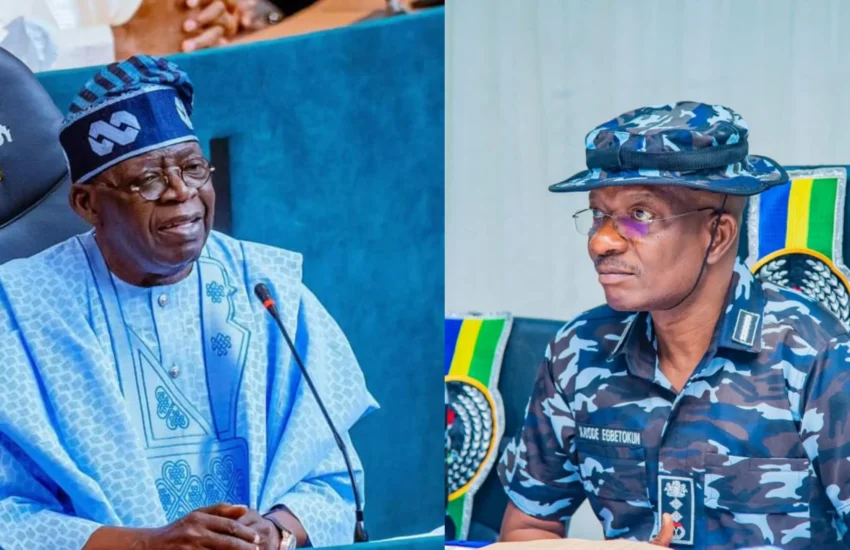
A centralized police force managed from Louis-Edet House, Abuja, simply cannot respond with the speed, local knowledge, or community trust that grassroots security demands. State Police, as championed by President Tinubu and increasingly endorsed by state assemblies from Kaduna to Sokoto, offers a credible structural solution.
Under this model, each state would recruit, train, fund, and deploy its own police force, with safeguards to prevent abuse by state executives. Officers would know their terrain, speak local languages, understand local conflict patterns, and respond within minutes, not hours, to distress calls.
Kaduna Governor Uba Sani has warned that Nigeria’s centralized policing structure can no longer secure the country , and he is right. The logic of State Police is not tribal or political, it is simply practical. The benefits of State Policing, when properly structured with accountability guardrails, are well-documented globally. Community policing reduces response times. Local officers are harder to bribe because they live among the people they protect and must answer to them daily. Intelligence gathering improves because residents trust officers they recognize.
States that have already established community guard corps, such as in Sokoto, Imo, Anambra, Ondo, among others, report measurable success. Such milestones are proofs that decentralization of security architecture is not theory, it is a tested and working strategy.
The safeguards for full implementation of state policing must be real; independent oversight boards, strict recruitment standards, strong federal coordination, and firm constitutional protections against state governors weaponizing local police against political opponents. These safeguards are non-negotiable. But their complexity is not an excuse to delay implementation any longer while Nigerians continue to bleed to death.
To ordinary Nigerians, especially those in communities living under the climate of fear and shadow of these recurring attacks, this writer appeals with both urgency and caution. Do not take the law into your hands.
The impulse is deeply human and entirely understandable. When the state fails you, when your neighbour is buried and the perpetrators roam free, the desire for revenge burns like fire. But mob justice has never once produced lasting peace in Nigeria, only more corpses, more grief, and more excuses for the powerful to delay real reform while pointing fingers at “communal violence.” We must resist that trap!
At the same time, every community has the natural and moral right to self-defense. Organize vigillance. Identify and report suspicious movements. Cooperate with security agencies. Build community alert systems. Know your exits. And above all, let no attackers ever return to their den (that is on the principles of self defense, and not reprisals).
Nigerians must also be vigillant about a different kind of predator — the politician. With elections on the horizon, the fragile security situation of the Middle Belt and indeed the entire country will inevitably become electoral currency.
Some will fan the flames of religious division to mobilize their base. Others will offer hollow promises of security reform that dissolve the morning after the votes are counted. Watch carefully who speaks of these tragedies with genuine grief and who speaks with gleaming ambition. Watch who proposes concrete, structural solutions like State Police, intelligence reform, and community security funding and who traffics only in outrage, condemnation and shrewd bias. The murders of Angwan Rukuba must not become campaign material.
Violence in North-central Nigeria is often painted as purely ethno-religious, but many experts say climate change, land competition, and the proliferation of small arms deepen these conflicts regardless of faith or ethnicity.  We must clearly demand nuances from our leaders and refuse simplistic narratives offered at election time.
The difference between Nigerians is not Muslim and Christian, not Northerner and Southerner, the difference is, profoundly, between those who choose to build and those who choose to destroy. The good citizens of this republic must now link arms across every divide and demand a country worthy of its people. We Demand State Police. We Demand accountability from Mr. President and every minister, governor, representative and general who draws a salary to keep citizens safe. We Demand that Angwan Rukuba be the last community burned while the nation watches.
It is right to mourn the dead. Behold, we should honour them not with tears alone, but with the fierce, patient, united work of building a Nigeria where no family must bury its children simply for existing. The hour is late. The cost of silence grows heavier with every passing day. Nigeria must choose, urgently and together, to live. If we fail to do so, then we have succeeded in becoming victims of the next attack(s)! May the sun shine tomorrow…