SPECIAL REPORT
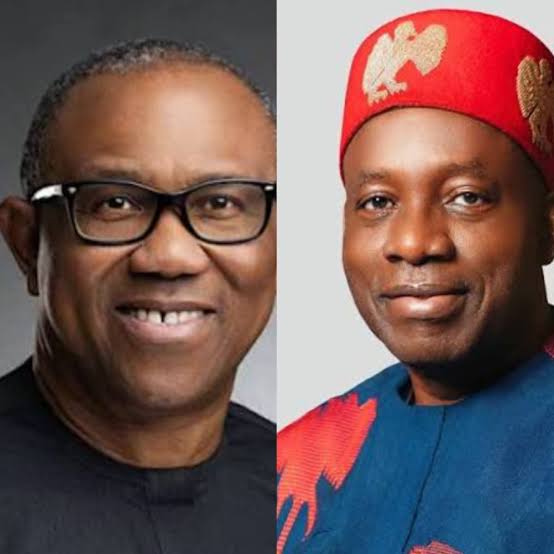
Few political relationships in Nigeria have undergone as dramatic a transformation as that between Chukwuma Charles Soludo and Peter Gregory Obi. At one point, the two men described themselves not merely as political associates but as friends and “brothers.” Today, their relationship has become one of the most enduring political quarrels in the South-East, with Soludo repeatedly taking aim at Obi’s record as governor of Anambra State, his political influence and, increasingly, his presidential ambitions.
Is Soludo’s persistent criticism of Obi driven by personal rivalry, political calculation, ideological disagreement, or a determination to defend his own record in Anambra? The evidence does not permit a definitive conclusion about his private motives. What is clear, however, is that the disagreement has evolved from an argument over public finance into a broader political contest over legacy, influence and the future direction of Anambra and the South-East.
The latest exchange demonstrates just how deep the quarrel has become. In September 2026, Soludo’s administration accused Obi of leaving substantial external-loan obligations and other liabilities in Anambra. Obi rejected the claims, insisting that he left office without outstanding salary, pension, gratuity or contractor obligations and challenged the state government to prove otherwise.
The Anambra government subsequently released figures which it said showed eight external loans associated with Obi’s administration, while Obi maintained that the government’s interpretation of the state’s finances was misleading.
This latest confrontation is important because it reveals that the Soludo-Obi dispute is no longer simply a clash between two politicians. It is a contest over historical memory: who should receive credit for Anambra’s progress, who should bear responsibility for its problems, and whose political narrative will dominate the state and perhaps the wider South-East.
The irony is that Soludo was not always an adversary of Obi. Soludo himself had acknowledged that he and Obi were friends and “brothers.” He also recalled that Obi had approached him in 2016 about joining the PDP and challenging Willie Obiano in the 2017 Anambra governorship election, an invitation Soludo declined.
Soludo further said that he had remained in APGA while Obi moved into the PDP and later the Labour Party.
It makes the subsequent bitterness more striking because the disagreement cannot easily be dismissed as a confrontation between political strangers. These are two prominent Anambra technocrats whose political careers became intertwined with the state’s modern history.
Obi governed Anambra from 2006 to 2014.
Soludo became governor in 2022 after the intervening administration of Willie Obiano. Both have cultivated reputations around competence, economic management and technocratic credentials.
Both men have had national ambitions. Both have enjoyed substantial influence among sections of the Igbo political and intellectual elite.
That similarity may be at the heart of the rivalry.
Politics is often fiercest between people who occupy similar political territory. Two politicians who have nothing in common may have little reason to quarrel. But when two men appeal to some of the same constituency, possess similar claims to competence and aspire to national relevance, competition can become intensely personal even when it is expressed in ideological or policy language.
Soludo’s criticism of Obi’s management of Anambra’s finances attracted national attention after he questioned the value of investments reportedly made by Obi while governor. Soludo argued that government should not be judged simply by how much money it saves but by the transformation it produces.
He also questioned whether saving public funds in bank accounts should be celebrated when citizens remain poor and infrastructure needs remain enormous.
The criticism was politically explosive because Obi was then enjoying a remarkable surge in popularity among young Nigerians under the Labour Party banner.
Soludo further argued that Obi lacked the political structure necessary to win the presidency and publicly declared that Obi could not win the 2023 election.
That statement transformed what could have remained an argument about governance into a political confrontation.
For Obi’s supporters, Soludo had crossed a line. For Soludo, however, the matter was about the right to disagree with a politician who had acquired an enormous following.
In his own defence, Soludo argued that democracy permitted disagreement and that nobody should be bullied into supporting Obi. He rejected suggestions that his criticism was motivated by envy and pointed out that he had previously encouraged Obi to return to APGA and pursue the presidency.
Whatever interpretation one places on Soludo’s later conduct, the historical record shows that his relationship with Obi was not originally defined by hostility.
What Soludo perhaps underestimated was the extraordinary emotional attachment that Obi had begun to generate among millions of young Nigerians.
The “Obidient” movement was bigger than the Labour Party machinery. It represented, for many of its supporters, dissatisfaction with the established political order. Obi became a symbol of a different political possibility.
This transformed criticism of Obi into something politically dangerous.
A criticism that might ordinarily have been interpreted as a disagreement between two former governors could now be interpreted by supporters as an attack on a movement.
Soludo complained that people who criticised Obi were bullied on social media. His argument was that no political figure should become so revered that criticism becomes unacceptable. That argument has a legitimate democratic basis.
When a politician repeatedly attacks an enormously popular rival, the public inevitably asks: Why him? Why so often? Why now?
At the heart of the dispute lies the question of legacy.
Peter Obi has built a substantial part of his political identity around his stewardship of Anambra. Supporters point to savings, investments, infrastructure, financial discipline and improvements in public institutions as evidence of his record.
Soludo, by contrast, has sought to establish his own political identity around a more ambitious transformation of Anambra.
His administration has emphasised infrastructure, security, urban development, economic formalisation and fiscal management.
For Soludo to establish the distinctiveness of his administration, he inevitably has to engage with the record of those who came before him.
That is normal politics.
But there is a danger.
A government can become so preoccupied with explaining what it inherited that it begins to sound as though its principal political project is to discredit its predecessor.
That is where criticism can become counterproductive.
The public is ultimately interested in what a government is doing with the resources at its disposal. Historical arguments matter, but they cannot substitute indefinitely for present performance.
The September 2026 dispute has taken the rivalry to a new level. Anambra Finance Commissioner Izuchukwu Okafor said the state was still servicing loans taken by previous administrations, including Obi’s.
The state government subsequently released records which it said showed eight external loans associated with Obi’s administration, with an outstanding balance that it calculated at about ₦127.4 billion as of June 30, 2026.
Obi rejected the allegation that he left Anambra with the kind of debt implied by the government’s claims.
He said his administration had cleared historical arrears and left the state financially stronger. He challenged Soludo’s administration to prove that he left the state owing money and said he would stop his presidential campaign if the claim could be substantiated.
The Anambra government responded by publishing what it described as loan records and arguing that Obi’s administration had contracted external loans for projects including healthcare, education, erosion management and agricultural development. It also disputed.
On loans, the relevant questions are straightforward:
What loans were contracted?
When were they contracted?
For what projects?
How much was disbursed?
How much was repaid before Obi left office?
What liabilities were inherited by Willie Obiano?
What liabilities were subsequently incurred?
What has been repaid by successive administrations?
And what exactly did the Debt Management Office records show at the relevant dates?
These questions deserve audited answers. They should not become weapons in an endless political war.
Is it envy? The allegation of envy is politically seductive because it provides a simple explanation for a complicated relationship.
Why would a former central bank governor and sitting state governor devote so much attention to a former governor who left office more than a decade ago?
Why would a man with his own national credentials appear so determined to challenge another man’s political narrative? Why does Peter Obi remain such a recurring subject in Soludo’s political interventions?
These are legitimate questions.
But they do not prove envy.
Indeed, Soludo has repeatedly denied being envious of Obi. In 2022, he pointed to his earlier effort to persuade Obi to return to APGA as evidence that he could hardly have been plotting against Obi’s presidential ambition at the time.
There is also a more mundane political explanation: competition.
Both men are prominent Anambra figures. Both have national political profiles. Obi’s enormous support among voters in the South-East inevitably affects the political environment in which Soludo operates.
In the 2023 presidential election, Obi won about 95 percent of the vote in Anambra in an election Soludo did not disguise his opposition to Obi’s venture.
That statistic is politically significant.
A sitting governor operating in a state where his former predecessor commands such overwhelming presidential support cannot simply pretend the former governor does not exist.
The question is therefore not whether Soludo has political reasons to engage Obi. He plainly does.
The question is whether the frequency and intensity of the attacks serve Anambra’s interests.
Or is it ambition?
The alternative explanation is ambition.
Soludo is an accomplished economist and former Central Bank governor. It is reasonable to observe that national political ambition can influence the behaviour of prominent politicians.
But motive should not be stated as fact without evidence.
What can be documented is that Soludo has made statements critical of Obi’s presidential aspirations and has continued to challenge Obi’s political propositions.
In 2025, for example, Soludo criticised politicians who promised to serve only one presidential term, describing such a pledge in highly disparaging terms.
Although he did not name Obi in the remarks reported at the time, the comments were widely interpreted as referring to Obi’s one-term proposal.
By 2026, the confrontation had entered another phase as Obi prepared for the 2027 presidential election.
Soludo has also publicly backed President Bola Tinubu’s 2027 re-election bid.
Against that backdrop, his attacks on Obi inevitably have a political context.
It is entirely possible for Soludo to oppose Obi politically without being motivated by envy. It is equally possible that personal rivalry and political calculation coexist. Human political behaviour is rarely driven by a single motive.
If Obi saved substantial money, that should be acknowledged.
If he contracted loans, the records should show them.
There is, however, a legitimate concern about the political utility of relentless attacks. Every time Soludo attacks Obi, he reminds Nigerians of Obi. Every time the governor challenges Obi’s record, he creates another opportunity for Obi’s supporters to mobilise. Every accusation invites a rebuttal. Every rebuttal generates another controversy.
The result can be a political cycle in which both men remain trapped in a relationship defined by antagonism.
This may explain why the phrase “shackled by envy or ambition” resonates with some observers. The image is of a politician who cannot completely escape the shadow of a predecessor.
The danger for Soludo is that the more frequently he attacks Obi, the more Nigerians may begin to see the dispute not as a debate over Anambra’s past but as a political struggle over its future. The danger for Obi is that his supporters may dismiss every criticism of his record as an act of malice, thereby shielding him from legitimate scrutiny.
Neither response serves democracy.
Anambra’s history should not be written by either camp alone.
It should be written by evidence. And if there is one lesson from the increasingly bitter Soludo-Obi saga, it is this: politicians may fight over legacy, but history ultimately belongs to the record.